De Quervain's Tenosynovitis.
What is De Quervain's tenosynovitis?
De Quervain's tenosynovitis is an inflammatory condition affecting the two tendons that run along the thumb side of the wrist — the abductor pollicis longus (APL) and extensor pollicis brevis (EPB) — as they pass through a narrow fibrous tunnel (the first extensor compartment) at the wrist. When these tendons become irritated and swollen, the tunnel becomes too tight to accommodate them comfortably, producing pain, swelling and stiffness on the thumb side of the wrist with movements involving the thumb and wrist.
The condition is sometimes called "mother's wrist" or "nanny's thumb" — colloquial names that reflect one of its most common presentations. New parents and carers frequently develop De Quervain's from the repetitive lifting of infants with the wrist in an ulnar-deviated, thumb-extended position — exactly the mechanics that load the APL and EPB most heavily.
What causes it?
De Quervain's is an overuse condition — it develops when the tendons are loaded repetitively or sustained beyond their capacity to recover, producing inflammation and thickening of the tendon and surrounding sheath. Risk factors include repetitive hand movements involving wrist and thumb actions such as typing, gardening, or certain sports, hormonal changes associated with pregnancy and the postpartum period, and inflammatory conditions such as rheumatoid arthritis.
Beyond new parents, it is common in racquet sport players, golfers, musicians, hairdressers, and anyone whose work involves repetitive gripping, pinching or wringing motions. Women are affected approximately six times more frequently than men.
What are the symptoms?
Pain and tenderness on the thumb side of the wrist, localised to the first extensor compartment just above the wrist. The pain is typically worse with movements that involve thumb abduction or extension combined with ulnar deviation of the wrist — lifting a cup, turning a key, picking up a baby, or wringing a cloth. Swelling may be visible over the affected area, and a creaking or catching sensation is sometimes felt with movement.
How is it diagnosed?
Finkelstein's test is the most characteristic clinical test — bending the thumb across the palm and then bending the fingers down over the thumb, then deviating the wrist toward the little finger side. Sharp pain over the first extensor compartment with this manoeuvre is highly specific for De Quervain's. A physiotherapist will also assess wrist range of motion, grip and pinch strength, and rule out other conditions including carpal tunnel syndrome, wrist arthritis and scapholunate ligament injury, which can produce similar symptoms.
Ultrasound confirms the diagnosis by visualising tendon sheath thickening and fluid, and can guide diagnostic or therapeutic injections when indicated.
How can physiotherapy help?
Physiotherapy is effective for most cases of De Quervain's, particularly when the condition is identified early and the aggravating activities can be modified.
In the acute phase, thumb spica splinting — a splint that immobilises the thumb and wrist — significantly reduces load on the inflamed tendons and allows pain to settle. This is particularly helpful for new parents who cannot fully rest the affected hand but can modify how they hold and lift their baby. Activity modification advice — adjusting grip technique, lifting strategies, and workplace ergonomics — reduces the repetitive loading that is maintaining the condition.
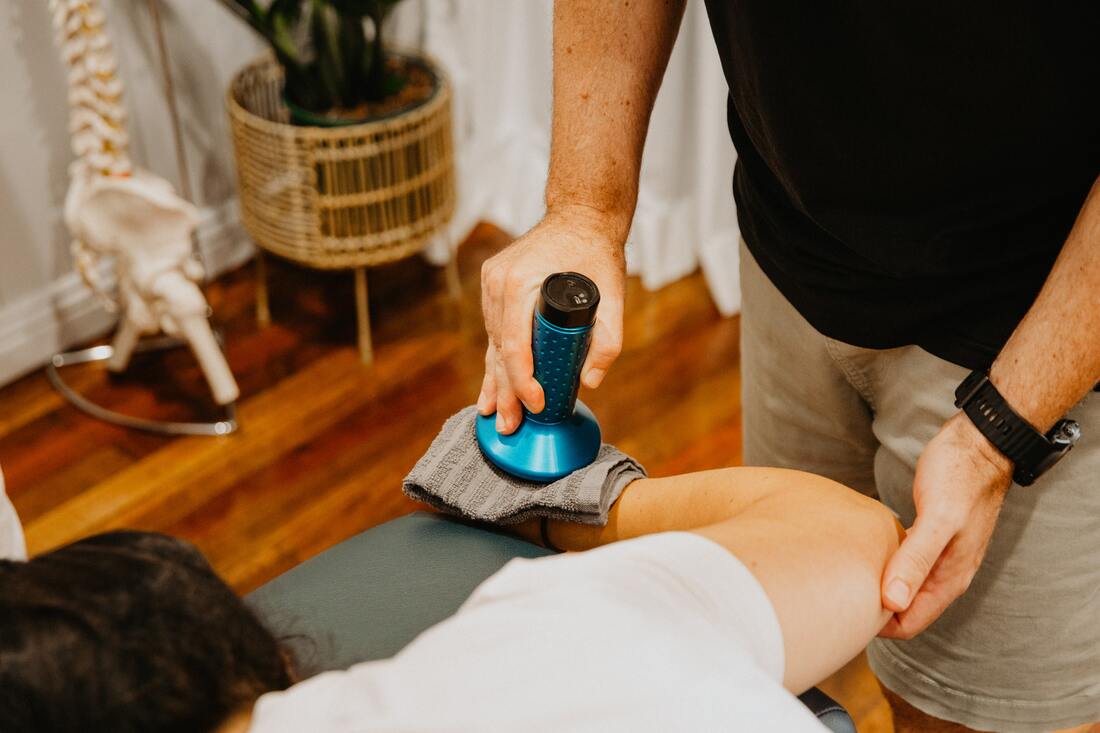
Manual therapy including tendon sheath and soft tissue release, and joint mobilisation of the thumb and wrist, improves local tissue mobility and reduces pain. Neural mobilisation of the radial nerve — which runs through the region and is often sensitised in De Quervain's — addresses the neural component that contributes to symptom persistence in some patients.
Progressive tendon loading through specific thumb and wrist strengthening exercises is central to full recovery and prevention of recurrence. Like other tendinopathies, De Quervain's responds well to a graded loading program that progressively increases tendon load as the inflammatory phase settles — simply resting without loading tends to produce temporary relief followed by recurrence when activity resumes. Dry needling of the surrounding musculature assists with pain management and muscle relaxation.
For patients not responding to physiotherapy, corticosteroid injection into the first extensor compartment — performed by a GP or specialist — is highly effective and produces lasting relief in the majority of cases. Surgery to release the first extensor compartment is rarely required but is effective for refractory cases.
For new parents specifically, we provide practical advice on positioning and carrying techniques that allow continued care of a baby while minimising tendon load — including alternative ways to support the baby's head, transfer positions, and adjustments to feeding and settling routines that protect the affected wrist.
Our physiotherapists Bethany Kippen and Yulia Khasyanova both have experience in upper limb and wrist conditions and are members of the Australian Physiotherapy Association. For patients whose De Quervain's developed in a workplace context, WorkCover funded physiotherapy may be available.
To book or find out more, call us on 07 3706 3407 or book online below. We see patients from across Brisbane's southside including Tarragindi, Coorparoo, Holland Park, Greenslopes and Mt Gravatt.
Who to book in with:
Emma Cameron
|
Yulia Khasyanova
|