Soccer Physiotherapy.
Physiotherapy for footballers across Brisbane's southside
Soccer is the most played sport in the world, and Brisbane's southside has a thriving football community spanning junior club competitions, school football, social and masters sides, and serious semi-professional players. The sport's combination of continuous running, repeated sprinting, rapid changes of direction, jumping, kicking and physical contact places a distinctive set of demands on the body — and produces a correspondingly distinctive injury profile that benefits from physiotherapy tailored to the specific demands of the game.
At Articulate Physiotherapy in Tarragindi, we work with footballers of all ages and levels — managing acute injuries from a single match, the overuse injuries that build across a long season, and the return-to-sport process that gets players back on the pitch safely and confidently. Our principal physiotherapist Mauricio Bara is an APA Sports Physiotherapist with extensive experience managing the lower limb injuries that dominate football, and our integrated physiotherapy and exercise physiology team means rehabilitation, strength and conditioning all happen under one roof.
The physical demands of soccer
Football is an intermittent, high-intensity sport. A single match involves several kilometres of running interspersed with repeated maximal sprints, sudden decelerations, cutting and pivoting, jumping for headers, and the asymmetric loading of kicking with a dominant leg. Players need cardiovascular endurance, lower limb power, rapid change-of-direction ability and the resilience to absorb both the cumulative load of training and the unpredictable forces of contact and tackling.
This profile concentrates injury risk in the lower limb — the ankle, knee, hamstring and groin in particular — and means that injury prevention and rehabilitation must address not just the injured tissue but the movement patterns, strength and loading habits that produced the injury in the first place.
Common soccer injuries
Ankle sprains are among the most common acute football injuries, accounting for a significant proportion of all time-loss injuries — primarily lateral ankle ligament sprains from landing, tackling, pivoting and uneven ground. The single most important clinical fact about football ankle sprains is the recurrence rate — without structured rehabilitation including proprioceptive and peroneal strengthening, a high proportion of players go on to sustain a second sprain, and repeated sprains lead to chronic ankle instability. Proprioceptive retraining and progressive functional rehabilitation are essential, not optional.
Hamstring strains are the most common muscle injury in soccer and the leading cause of missed match time. They occur predominantly during high-speed running and sprinting — the late swing phase of the running cycle and the deceleration after a sprint being the highest-risk moments. The recurrence rate of hamstring strains without structured graduated rehabilitation is high, which is why management built around progressive eccentric loading — exercises like the Nordic hamstring exercise — and a structured return to maximal sprinting is the standard of care. See our hamstring injuries page for detail.
Knee injuries are the most significant injuries in football in terms of severity and time lost. ACL tears from non-contact pivoting and deceleration mechanisms, meniscal tears from rotational loading, MCL injuries from contact to the outside of the knee, and patellofemoral pain from the cumulative knee loading of high-volume football are the most common presentations. Female footballers have a significantly higher ACL injury rate than male players — a difference driven by a combination of biomechanical, hormonal and neuromuscular factors that injury prevention programs specifically target.
Groin and hip injuries — adductor (groin) strains from kicking and rapid direction change, and longer-term hip and groin overload presentations — are common in footballers given the repeated kicking and cutting demands of the sport. Adductor strength and the management of training load are central to both treating and preventing these injuries.
Calf and lower leg injuries — calf strains, Achilles tendinopathy and shin splints (medial tibial stress syndrome) — develop from the high sprinting and running volumes of football, particularly during pre-season and periods of rapid training load increase.
Overuse and growth-related injuries in junior players — in younger footballers, conditions like Osgood-Schlatter disease and Sever's disease are common during growth spurts and respond well to load management and physiotherapy. See our growth-related conditions page for more.
How physiotherapy helps
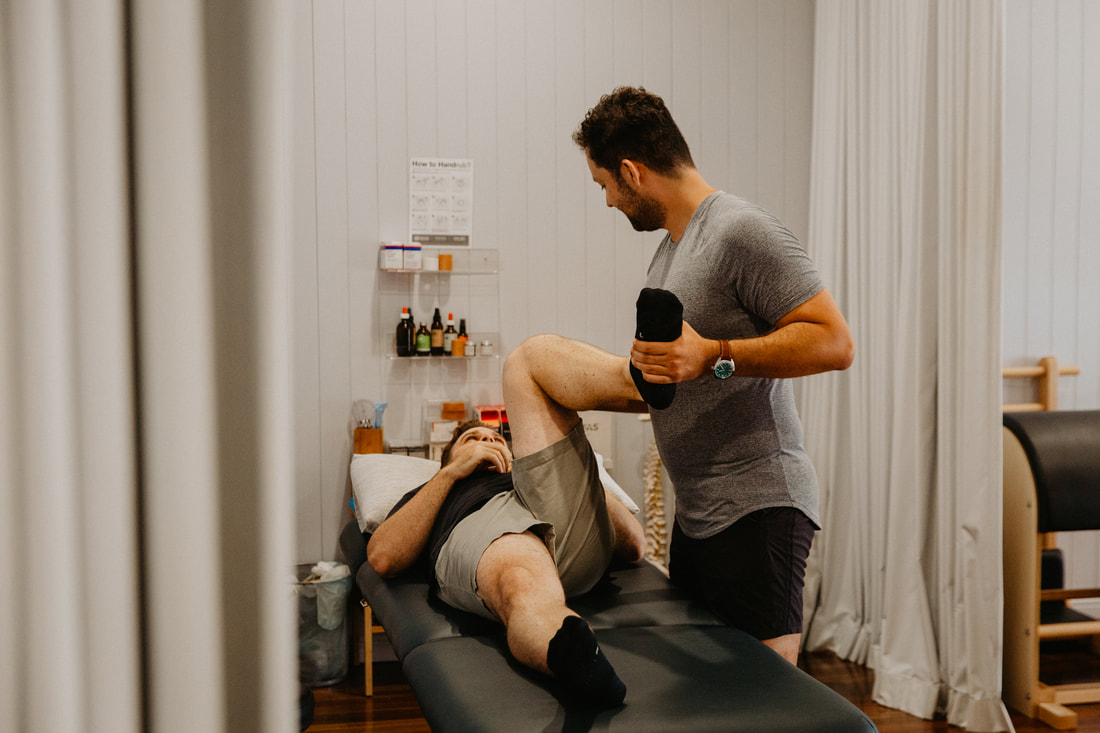
Physiotherapy plays a central role across the full spectrum of football injury — from accurate diagnosis through acute management, structured rehabilitation and a criteria-based return to play. Following an acute injury, your physiotherapist will perform a thorough assessment to establish the diagnosis, identify any associated injuries and determine whether imaging or referral is needed. Treatment then combines hands-on manual therapy to manage pain and restore mobility, progressive exercise rehabilitation to rebuild strength and control, and biomechanical assessment to address the movement patterns that contributed to the injury.
The return-to-play decision is one of the most important in football rehabilitation, because returning too early is a primary driver of re-injury — particularly for hamstring and ankle injuries. At Articulate we use criteria-based progression rather than time-based assumptions, using objective strength testing and functional assessment to confirm a player is genuinely ready for the demands of training and competition before they return.
Injury prevention
Football has the best-developed injury prevention evidence base of any team sport. The FIFA 11+ program — a structured warm-up incorporating running, strength, plyometric and balance components — has the strongest evidence base of any sports injury prevention program, shown to reduce overall injury rates by around 30% and ACL injuries in women's football by approximately 45%. The key to its effectiveness is consistency — the programs work when performed regularly as part of the standard warm-up, and high adherence produces substantially greater injury reduction than occasional use.
Our physiotherapists and exercise physiologist can assess individual players for the specific risk factors that predispose to football injury — hamstring strength and the strength balance between sides, hip and adductor strength, single-leg control and landing mechanics — and build targeted prevention programs for individuals, and provide guidance to coaches implementing team-wide prevention warm-ups.
Strength and conditioning
For footballers wanting to build the physical capacity that both improves performance and reduces injury risk, our exercise physiologist Ash O'Regan provides structured strength and conditioning programming. Our clinical exercise classes offer a controlled environment for building lower limb strength, control and resilience — particularly valuable for players returning from injury who need a structured bridge between rehabilitation and a full return to training.
Booking
Whether you've picked up an injury, you're managing a niggle through the season, or you want to build the strength and resilience to stay on the pitch, our team would love to help. Our physiotherapists Mauricio Bara and Eliane Machado — whose PhD is in lower limb and running biomechanics — both have specific expertise relevant to football injury, and are members of the Australian Physiotherapy Association.
To book or find out more, call us on 07 3706 3407 or book online below. We see players from across Brisbane's southside including Tarragindi, Coorparoo, Holland Park, Greenslopes and Mt Gravatt.
Soccer is the most played sport in the world, and Brisbane's southside has a thriving football community spanning junior club competitions, school football, social and masters sides, and serious semi-professional players. The sport's combination of continuous running, repeated sprinting, rapid changes of direction, jumping, kicking and physical contact places a distinctive set of demands on the body — and produces a correspondingly distinctive injury profile that benefits from physiotherapy tailored to the specific demands of the game.
At Articulate Physiotherapy in Tarragindi, we work with footballers of all ages and levels — managing acute injuries from a single match, the overuse injuries that build across a long season, and the return-to-sport process that gets players back on the pitch safely and confidently. Our principal physiotherapist Mauricio Bara is an APA Sports Physiotherapist with extensive experience managing the lower limb injuries that dominate football, and our integrated physiotherapy and exercise physiology team means rehabilitation, strength and conditioning all happen under one roof.
The physical demands of soccer
Football is an intermittent, high-intensity sport. A single match involves several kilometres of running interspersed with repeated maximal sprints, sudden decelerations, cutting and pivoting, jumping for headers, and the asymmetric loading of kicking with a dominant leg. Players need cardiovascular endurance, lower limb power, rapid change-of-direction ability and the resilience to absorb both the cumulative load of training and the unpredictable forces of contact and tackling.
This profile concentrates injury risk in the lower limb — the ankle, knee, hamstring and groin in particular — and means that injury prevention and rehabilitation must address not just the injured tissue but the movement patterns, strength and loading habits that produced the injury in the first place.
Common soccer injuries
Ankle sprains are among the most common acute football injuries, accounting for a significant proportion of all time-loss injuries — primarily lateral ankle ligament sprains from landing, tackling, pivoting and uneven ground. The single most important clinical fact about football ankle sprains is the recurrence rate — without structured rehabilitation including proprioceptive and peroneal strengthening, a high proportion of players go on to sustain a second sprain, and repeated sprains lead to chronic ankle instability. Proprioceptive retraining and progressive functional rehabilitation are essential, not optional.
Hamstring strains are the most common muscle injury in soccer and the leading cause of missed match time. They occur predominantly during high-speed running and sprinting — the late swing phase of the running cycle and the deceleration after a sprint being the highest-risk moments. The recurrence rate of hamstring strains without structured graduated rehabilitation is high, which is why management built around progressive eccentric loading — exercises like the Nordic hamstring exercise — and a structured return to maximal sprinting is the standard of care. See our hamstring injuries page for detail.
Knee injuries are the most significant injuries in football in terms of severity and time lost. ACL tears from non-contact pivoting and deceleration mechanisms, meniscal tears from rotational loading, MCL injuries from contact to the outside of the knee, and patellofemoral pain from the cumulative knee loading of high-volume football are the most common presentations. Female footballers have a significantly higher ACL injury rate than male players — a difference driven by a combination of biomechanical, hormonal and neuromuscular factors that injury prevention programs specifically target.
Groin and hip injuries — adductor (groin) strains from kicking and rapid direction change, and longer-term hip and groin overload presentations — are common in footballers given the repeated kicking and cutting demands of the sport. Adductor strength and the management of training load are central to both treating and preventing these injuries.
Calf and lower leg injuries — calf strains, Achilles tendinopathy and shin splints (medial tibial stress syndrome) — develop from the high sprinting and running volumes of football, particularly during pre-season and periods of rapid training load increase.
Overuse and growth-related injuries in junior players — in younger footballers, conditions like Osgood-Schlatter disease and Sever's disease are common during growth spurts and respond well to load management and physiotherapy. See our growth-related conditions page for more.
How physiotherapy helps
Physiotherapy plays a central role across the full spectrum of football injury — from accurate diagnosis through acute management, structured rehabilitation and a criteria-based return to play. Following an acute injury, your physiotherapist will perform a thorough assessment to establish the diagnosis, identify any associated injuries and determine whether imaging or referral is needed. Treatment then combines hands-on manual therapy to manage pain and restore mobility, progressive exercise rehabilitation to rebuild strength and control, and biomechanical assessment to address the movement patterns that contributed to the injury.
The return-to-play decision is one of the most important in football rehabilitation, because returning too early is a primary driver of re-injury — particularly for hamstring and ankle injuries. At Articulate we use criteria-based progression rather than time-based assumptions, using objective strength testing and functional assessment to confirm a player is genuinely ready for the demands of training and competition before they return.
Injury prevention
Football has the best-developed injury prevention evidence base of any team sport. The FIFA 11+ program — a structured warm-up incorporating running, strength, plyometric and balance components — has the strongest evidence base of any sports injury prevention program, shown to reduce overall injury rates by around 30% and ACL injuries in women's football by approximately 45%. The key to its effectiveness is consistency — the programs work when performed regularly as part of the standard warm-up, and high adherence produces substantially greater injury reduction than occasional use.
Our physiotherapists and exercise physiologist can assess individual players for the specific risk factors that predispose to football injury — hamstring strength and the strength balance between sides, hip and adductor strength, single-leg control and landing mechanics — and build targeted prevention programs for individuals, and provide guidance to coaches implementing team-wide prevention warm-ups.
Strength and conditioning
For footballers wanting to build the physical capacity that both improves performance and reduces injury risk, our exercise physiologist Ash O'Regan provides structured strength and conditioning programming. Our clinical exercise classes offer a controlled environment for building lower limb strength, control and resilience — particularly valuable for players returning from injury who need a structured bridge between rehabilitation and a full return to training.
Booking
Whether you've picked up an injury, you're managing a niggle through the season, or you want to build the strength and resilience to stay on the pitch, our team would love to help. Our physiotherapists Mauricio Bara and Eliane Machado — whose PhD is in lower limb and running biomechanics — both have specific expertise relevant to football injury, and are members of the Australian Physiotherapy Association.
To book or find out more, call us on 07 3706 3407 or book online below. We see players from across Brisbane's southside including Tarragindi, Coorparoo, Holland Park, Greenslopes and Mt Gravatt.
Who to book in with:
Dr Eliane Machado Phd
|
Mauricio Bara
|
Ash O'Regan
|