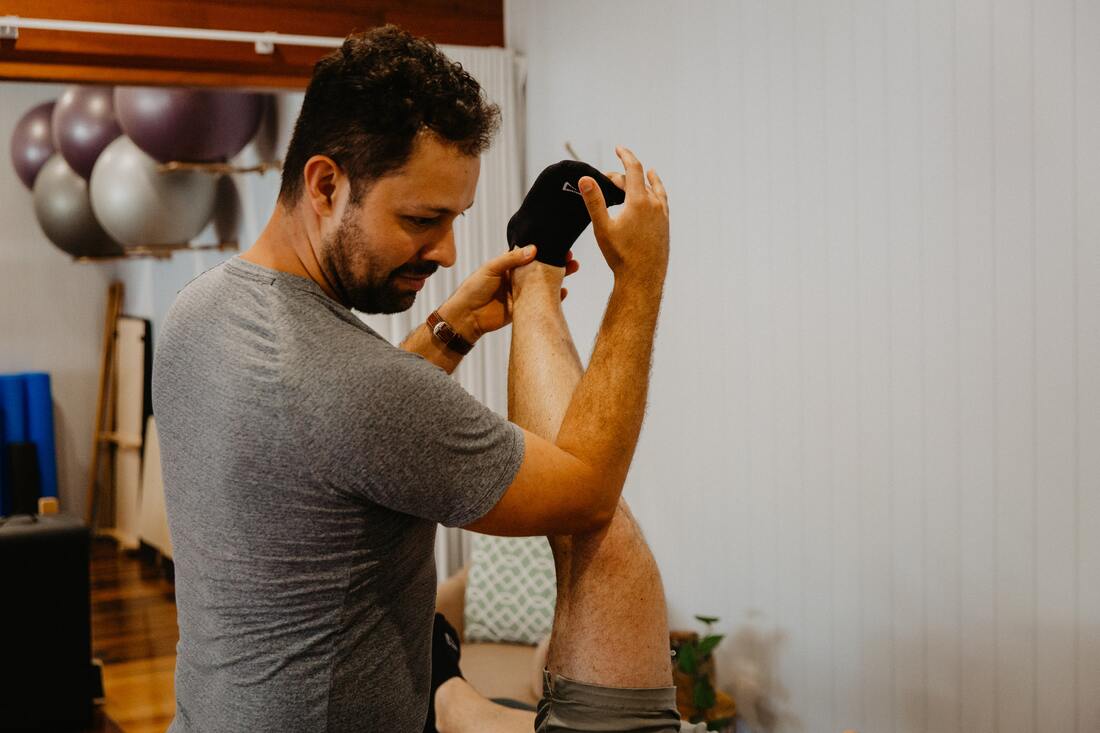
Foot and ankle physiotherapist Brisbane southside.
Feet and ankles play a crucial role in our daily lives, providing support, stability, and mobility. As a result, they are also more prone to injuries, which can cause significant pain and discomfort and affect our ability to perform daily activities. Ankle and foot injuries are fairly prevalent in Australia and frequently occur during sport, most commonly in soccer and rugby. In Australia, ankle injuries annually account for 5.9% of all sporting injuries requiring hospitalisations. The highest ankle injury incidence lies between the ages of 15-17. Ankle injury types vary from fractures, ligament tears, tendon injuries such as rupture and tendinopathies. Whether you are an athlete, a senior, or anyone in between, our team of experienced physiotherapists can help you recover from foot and ankle injuries and get back to your daily routine. Common causes of foot and ankle pain we work with include:
Ankle Ligament Injuries
The ligaments in our ankles provide the stability to our lower limbs and help us to balance. Ankle ligament injuries on the lateral ankle are the most common ligament injury type, making up 85% of all ankle sprains. The ligaments of the lateral ankle are the: anterior talofibular ligament, calcaneofibular ligament and posterior talofibular ligament. The medial ankle is made up of four thick, strong ligaments (posterior tibiotalar ligament, anterior tibiotalar ligament, tibiocalcaneal ligament and tibionavicular ligament) that make up a ligamentous complex called the ‘deltoid ligament’. The deltoid ligament is strong and as such, medial ankle injuries occur less frequently but when are often severe and with a more significant mechanism of injury. Ankle injuries can also occur above the ankle joint called these are called ‘high ankle ligament sprains’ and are located at the joint between our tibia and fibula.
When ligament damage occurs, there is often a long period of recovery and return to sport is based on severity of the injury. With correct treatment, a grade I injury expected return to activity is 2-4 weeks, a grade II or III return to sport is 6-8 weeks and if the injury was severe enough to require surgery, then expected return to activity is 12-16 weeks. For the more severe injury grades, in order to return to optimal function and to minimise the risk of re-injury- which occurs in 70% of lateral ankle sprains- physiotherapy should commence to restore function. Physiotherapy for ankle injuries involves range of motion exercises, actively regaining stability, and motor coordination to improve balance to ensure a safe return to activity.
Ankle Tendon Impairments
Like with ligament injuries, tendon impairments can occur around the ankle, commonly occurring in our lateral tendons known as ‘the peroneals’ (peroneus brevis, longus and tertius). These muscles provide active stability to our ankle and assist in the turning our (eversion) of our foot. Tendon ruptures can occur with similar inversion mechanisms to lateral ankle sprains or tendinopathies can occur gradually with overloading of the tendon with such as increased walking, running, wearing incorrect footwear or may be due to lower limb muscle imbalances. Physiotherapy can help to strengthen the muscles and tendons, improve stability, and restore tendon strength and reduce pain associated with tendinopathy.
Ankle injuries can be problematic and without appropriate care, duration of recovery can be longer than expected. If you are presenting with a foot or ankle injury come in and see our physiotherapists today. Call us on 07 3706 3407 or email [email protected]. Our friendly Coorparoo and Tarragindi physiotherapists would love to help.
- Plantar Fasciitis: This condition causes pain in the heel or arch of the foot due to inflammation of the plantar fascia, a thick band of tissue that runs along the bottom of the foot. Treatment may include stretching and strengthening exercises, manual therapy, and orthotics to support the foot.
- Achilles Tendinopathy: Achilles tendinopathy refers to pain, stiffness, and swelling in the Achilles tendon, which connects the calf muscles to the heel bone. Treatment may involve a combination of exercises to improve strength and flexibility, manual therapy, and activity modification.
- Ankle Sprains: Ankle sprains occur when the ligaments that support the ankle are stretched or torn, often due to a sudden twisting motion. Treatment may involve rest, ice, compression, and elevation (RICE), as well as exercises to improve strength and stability in the ankle.
- Morton's Neuroma: Morton's Neuroma is a painful condition that affects the ball of the foot, typically between the third and fourth toes. It is caused by the thickening of tissue around one of the nerves leading to the toes. Treatment may include footwear modifications, custom orthotics, and manual therapy.
- Tarsal Tunnel Syndrome: This condition occurs when the tibial nerve in the ankle is compressed, causing pain, tingling, and numbness in the foot. Treatment may involve a combination of manual therapy, nerve gliding exercises, and activity modification to reduce pressure on the nerve.
- Metatarsalgia: Metatarsalgia is a condition that causes pain and inflammation in the ball of the foot. Treatment may involve footwear modifications, custom orthotics, and exercises to improve the strength and flexibility of the foot and ankle.
- Posterior Tibial Tendonitis: This condition occurs when the tendon that runs along the inside of the ankle and foot becomes inflamed. It can cause pain, swelling, and difficulty walking. Treatment may involve exercises to improve strength and flexibility, manual therapy, and orthotics to support the foot.
- Gout: Gout is a type of arthritis that can cause sudden and severe pain, swelling, and redness in the joints, including the foot and ankle. Treatment may involve medication to manage pain and inflammation, as well as exercises to improve range of motion and strength in the affected joint.
- Stress Fractures: Stress fractures are tiny cracks in the bone that can occur due to overuse or repetitive stress. They often cause pain, swelling, and tenderness in the affected area. Treatment may involve rest, immobilisation, and a gradual return to activity with a focus on proper technique and biomechanics.
- Osteoarthritis: Osteoarthritis is a degenerative joint condition that can affect the foot and ankle. It can cause pain, stiffness, and decreased mobility in the affected joint. Treatment may involve exercises to improve strength and flexibility, manual therapy, and education on proper body mechanics and ergonomics.
- Ankle Fractures: Ankle fractures can occur on the talus (the foot bone that forms half of the ankle joint), the medial or lateral malleoli (the bony prominences at the sides the ankle), or distal tibial fractures that occur just above the ankle joint itself. Although not often seen in the acute phase at a physiotherapy clinic often can be detected using prognostic tools if an x-ray has not been completed. Furthermore, long periods of immobilisation following casting of a fracture can lead to stiffness and reduced muscle length and as such physiotherapists help to improve range of motion, muscle length and decrease stiffness to improve ankle function.
Ankle Ligament Injuries
The ligaments in our ankles provide the stability to our lower limbs and help us to balance. Ankle ligament injuries on the lateral ankle are the most common ligament injury type, making up 85% of all ankle sprains. The ligaments of the lateral ankle are the: anterior talofibular ligament, calcaneofibular ligament and posterior talofibular ligament. The medial ankle is made up of four thick, strong ligaments (posterior tibiotalar ligament, anterior tibiotalar ligament, tibiocalcaneal ligament and tibionavicular ligament) that make up a ligamentous complex called the ‘deltoid ligament’. The deltoid ligament is strong and as such, medial ankle injuries occur less frequently but when are often severe and with a more significant mechanism of injury. Ankle injuries can also occur above the ankle joint called these are called ‘high ankle ligament sprains’ and are located at the joint between our tibia and fibula.
When ligament damage occurs, there is often a long period of recovery and return to sport is based on severity of the injury. With correct treatment, a grade I injury expected return to activity is 2-4 weeks, a grade II or III return to sport is 6-8 weeks and if the injury was severe enough to require surgery, then expected return to activity is 12-16 weeks. For the more severe injury grades, in order to return to optimal function and to minimise the risk of re-injury- which occurs in 70% of lateral ankle sprains- physiotherapy should commence to restore function. Physiotherapy for ankle injuries involves range of motion exercises, actively regaining stability, and motor coordination to improve balance to ensure a safe return to activity.
Ankle Tendon Impairments
Like with ligament injuries, tendon impairments can occur around the ankle, commonly occurring in our lateral tendons known as ‘the peroneals’ (peroneus brevis, longus and tertius). These muscles provide active stability to our ankle and assist in the turning our (eversion) of our foot. Tendon ruptures can occur with similar inversion mechanisms to lateral ankle sprains or tendinopathies can occur gradually with overloading of the tendon with such as increased walking, running, wearing incorrect footwear or may be due to lower limb muscle imbalances. Physiotherapy can help to strengthen the muscles and tendons, improve stability, and restore tendon strength and reduce pain associated with tendinopathy.
Ankle injuries can be problematic and without appropriate care, duration of recovery can be longer than expected. If you are presenting with a foot or ankle injury come in and see our physiotherapists today. Call us on 07 3706 3407 or email [email protected]. Our friendly Coorparoo and Tarragindi physiotherapists would love to help.
|
|
|