Real Time Ultrasound.
What is real time ultrasound in physiotherapy?
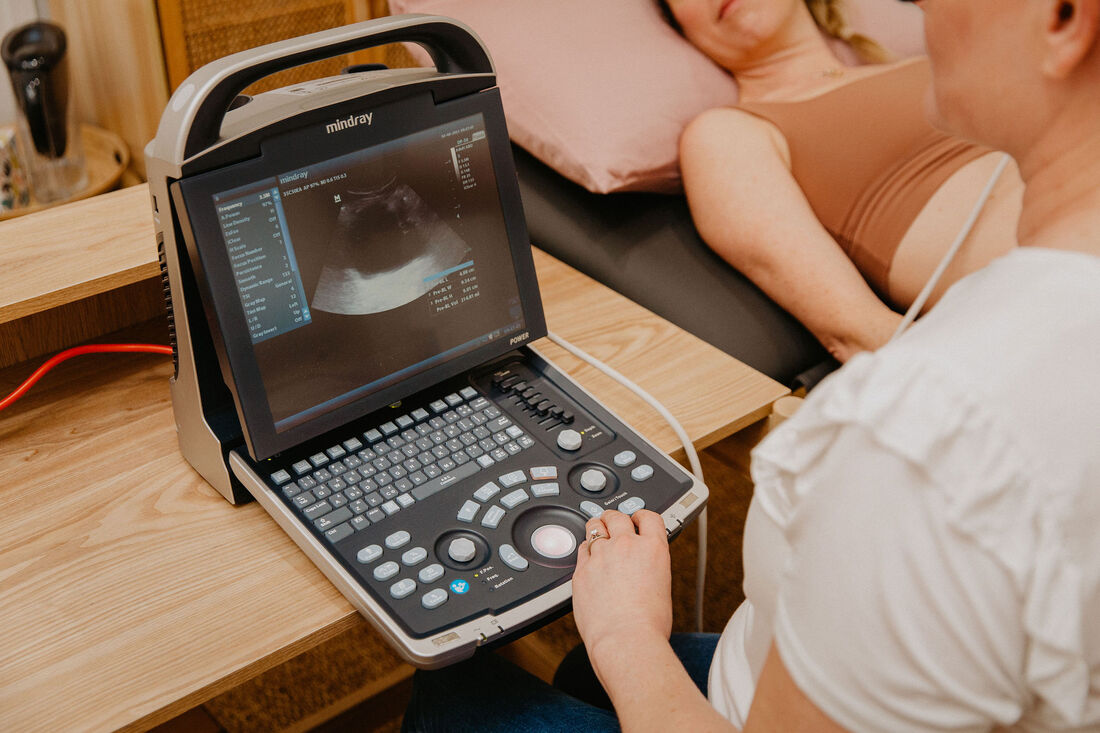
Real time ultrasound (RTUS) is a diagnostic and rehabilitation tool that uses high-frequency sound waves to produce live, two-dimensional images of the body's internal structures on a screen. Unlike static imaging — such as X-ray or MRI — real time ultrasound shows what is happening inside the body as it happens, allowing both the physiotherapist and the patient to watch muscles contracting, tendons moving and structures functioning in real time during assessment and exercise.
At Articulate Physiotherapy in Tarragindi, we use the Mindray DC40 real time ultrasound unit — a high-resolution clinical ultrasound system — as a standard part of our assessment and rehabilitation toolkit across a broad range of presentations. It is used in many routine physiotherapy appointments, not only in specialist or complex cases.
How physiotherapists use real time ultrasound differently to diagnostic imaging
There is an important distinction between diagnostic ultrasound — where a radiologist or sonographer produces images for diagnosis — and the real time ultrasound that physiotherapists use in rehabilitation. Physiotherapy real time ultrasound is primarily a biofeedback and retraining tool. The physiotherapist uses it to watch specific muscles activating — or failing to activate — during exercise, providing immediate visual feedback that accelerates the retraining process dramatically compared to verbal cueing alone.
This distinction matters because physiotherapy real time ultrasound is used for a different purpose: not primarily to diagnose a structural abnormality, but to confirm that the correct muscle is activating correctly during rehabilitation exercises. Patients can watch their own muscles on the screen, which transforms abstract verbal instructions ("tighten your deep abdominals") into concrete, visible feedback.
What conditions is real time ultrasound used for?
Deep stabiliser retraining is the primary rehabilitation application of real time ultrasound in physiotherapy. The deep stabilising muscles of the spine — transversus abdominis and multifidus — are consistently inhibited by pain, surgery and injury. Retraining them requires the patient to selectively activate these small deep muscles rather than the larger superficial muscles that habitually substitute. Real time ultrasound makes this possible by directly visualising the deep muscles during exercise — confirming the correct muscle is activating, at the right timing and with the right amount of effort. Without this visual feedback, many patients contract the wrong muscles while believing they are doing the exercise correctly.
Lower back pain and spinal conditions — multifidus and transversus abdominis retraining is a foundational component of lumbar rehabilitation for disc, facet, SIJ and non-specific back pain presentations.
Neck pain and cervicogenic headache — deep cervical flexor retraining using real time ultrasound to visualise longus colli and longus capitis activation is one of the most evidence-based interventions for chronic neck pain and cervicogenic headache.
Postnatal rehabilitation and diastasis recti — real time ultrasound directly measures the degree of abdominal separation at the linea alba and monitors how it responds to loading and exercise. It guides safe abdominal rehabilitation in the postnatal period, providing objective measurement of progress rather than relying on subjective assessment alone.
Women's health and pelvic floor assessment — real time ultrasound can be used to visualise pelvic floor muscle function during contraction and relaxation, providing an alternative assessment method for patients who find internal examination uncomfortable or prefer a non-invasive option. It can also assess bladder volume and identify urinary retention.
Rotator cuff conditions and shoulder rehabilitation — visualising rotator cuff activation patterns during rehabilitation exercises confirms correct muscle sequencing and identifies the compensatory strategies that perpetuate shoulder pain.
Hip and knee rehabilitation — gluteus medius, VMO and deep hip stabiliser retraining with real time ultrasound confirms correct activation in the muscles most commonly inhibited by pain and injury.
Pelvic girdle pain during pregnancy — guiding safe deep core activation in pregnant women where standard spinal rehabilitation exercises need modification.
Tendon assessment — monitoring tendon structure and healing during rehabilitation for Achilles tendinopathy, patellar tendinopathy and rotator cuff tendinopathy provides objective data on structural change alongside functional improvement.
What are the benefits of real time ultrasound?
Using real-time ultrasound in physiotherapy offers several benefits including accurate diagnosis through a clear and accurate picture of internal structures, an alternative assessment method for patients who feel anxious about internal examination, important information about bladder volumes and urinary retention, and non-invasive assessment without the need for surgery or other invasive procedures. Real-time imaging allows physiotherapists to see inside the body in real-time, providing a clearer picture of the structures and tissues causing pain or discomfort. Ultrasound imaging can also be used to monitor the healing process of injuries, allowing physiotherapists to track progress and adjust treatment plans as necessary.
The biofeedback benefit is the most clinically significant for rehabilitation. Patients who can watch their own muscles contracting on the screen learn the correct activation pattern dramatically faster than patients relying on verbal feedback alone. For deep muscles that cannot be felt from the outside and are difficult to isolate through voluntary effort, this visual feedback can make the difference between effective rehabilitation and months of unsuccessful exercise attempts.
Is real time ultrasound safe?
Yes — ultrasound uses sound waves rather than radiation and is the same technology used in obstetric and cardiac imaging. It has an excellent safety profile and is used routinely with pregnant women, children and adults of all ages. There is no ionising radiation and no known adverse effects from therapeutic or diagnostic ultrasound at the frequencies used in clinical practice.
Is it included in a standard physiotherapy appointment?
Real time ultrasound is available as part of standard physiotherapy appointments at Articulate and does not require a separate booking. If real time ultrasound is clinically relevant to your presentation, your physiotherapist will incorporate it into your assessment and rehabilitation as appropriate. There is no additional charge for its use within a standard appointment.
Our physiotherapists Mauricio Bara, Yulia Khasyanova, Eliane Machado, Bethany Kippen and Emma Cameron are all trained in real time ultrasound and incorporate it into clinical practice where appropriate.
To book or find out more, call us on 07 3706 3407 or book online below. We see patients from across Brisbane's southside including Tarragindi, Coorparoo, Holland Park, Greenslopes and Mt Gravatt.
Real time ultrasound (RTUS) is a diagnostic and rehabilitation tool that uses high-frequency sound waves to produce live, two-dimensional images of the body's internal structures on a screen. Unlike static imaging — such as X-ray or MRI — real time ultrasound shows what is happening inside the body as it happens, allowing both the physiotherapist and the patient to watch muscles contracting, tendons moving and structures functioning in real time during assessment and exercise.
At Articulate Physiotherapy in Tarragindi, we use the Mindray DC40 real time ultrasound unit — a high-resolution clinical ultrasound system — as a standard part of our assessment and rehabilitation toolkit across a broad range of presentations. It is used in many routine physiotherapy appointments, not only in specialist or complex cases.
How physiotherapists use real time ultrasound differently to diagnostic imaging
There is an important distinction between diagnostic ultrasound — where a radiologist or sonographer produces images for diagnosis — and the real time ultrasound that physiotherapists use in rehabilitation. Physiotherapy real time ultrasound is primarily a biofeedback and retraining tool. The physiotherapist uses it to watch specific muscles activating — or failing to activate — during exercise, providing immediate visual feedback that accelerates the retraining process dramatically compared to verbal cueing alone.
This distinction matters because physiotherapy real time ultrasound is used for a different purpose: not primarily to diagnose a structural abnormality, but to confirm that the correct muscle is activating correctly during rehabilitation exercises. Patients can watch their own muscles on the screen, which transforms abstract verbal instructions ("tighten your deep abdominals") into concrete, visible feedback.
What conditions is real time ultrasound used for?
Deep stabiliser retraining is the primary rehabilitation application of real time ultrasound in physiotherapy. The deep stabilising muscles of the spine — transversus abdominis and multifidus — are consistently inhibited by pain, surgery and injury. Retraining them requires the patient to selectively activate these small deep muscles rather than the larger superficial muscles that habitually substitute. Real time ultrasound makes this possible by directly visualising the deep muscles during exercise — confirming the correct muscle is activating, at the right timing and with the right amount of effort. Without this visual feedback, many patients contract the wrong muscles while believing they are doing the exercise correctly.
Lower back pain and spinal conditions — multifidus and transversus abdominis retraining is a foundational component of lumbar rehabilitation for disc, facet, SIJ and non-specific back pain presentations.
Neck pain and cervicogenic headache — deep cervical flexor retraining using real time ultrasound to visualise longus colli and longus capitis activation is one of the most evidence-based interventions for chronic neck pain and cervicogenic headache.
Postnatal rehabilitation and diastasis recti — real time ultrasound directly measures the degree of abdominal separation at the linea alba and monitors how it responds to loading and exercise. It guides safe abdominal rehabilitation in the postnatal period, providing objective measurement of progress rather than relying on subjective assessment alone.
Women's health and pelvic floor assessment — real time ultrasound can be used to visualise pelvic floor muscle function during contraction and relaxation, providing an alternative assessment method for patients who find internal examination uncomfortable or prefer a non-invasive option. It can also assess bladder volume and identify urinary retention.
Rotator cuff conditions and shoulder rehabilitation — visualising rotator cuff activation patterns during rehabilitation exercises confirms correct muscle sequencing and identifies the compensatory strategies that perpetuate shoulder pain.
Hip and knee rehabilitation — gluteus medius, VMO and deep hip stabiliser retraining with real time ultrasound confirms correct activation in the muscles most commonly inhibited by pain and injury.
Pelvic girdle pain during pregnancy — guiding safe deep core activation in pregnant women where standard spinal rehabilitation exercises need modification.
Tendon assessment — monitoring tendon structure and healing during rehabilitation for Achilles tendinopathy, patellar tendinopathy and rotator cuff tendinopathy provides objective data on structural change alongside functional improvement.
What are the benefits of real time ultrasound?
Using real-time ultrasound in physiotherapy offers several benefits including accurate diagnosis through a clear and accurate picture of internal structures, an alternative assessment method for patients who feel anxious about internal examination, important information about bladder volumes and urinary retention, and non-invasive assessment without the need for surgery or other invasive procedures. Real-time imaging allows physiotherapists to see inside the body in real-time, providing a clearer picture of the structures and tissues causing pain or discomfort. Ultrasound imaging can also be used to monitor the healing process of injuries, allowing physiotherapists to track progress and adjust treatment plans as necessary.
The biofeedback benefit is the most clinically significant for rehabilitation. Patients who can watch their own muscles contracting on the screen learn the correct activation pattern dramatically faster than patients relying on verbal feedback alone. For deep muscles that cannot be felt from the outside and are difficult to isolate through voluntary effort, this visual feedback can make the difference between effective rehabilitation and months of unsuccessful exercise attempts.
Is real time ultrasound safe?
Yes — ultrasound uses sound waves rather than radiation and is the same technology used in obstetric and cardiac imaging. It has an excellent safety profile and is used routinely with pregnant women, children and adults of all ages. There is no ionising radiation and no known adverse effects from therapeutic or diagnostic ultrasound at the frequencies used in clinical practice.
Is it included in a standard physiotherapy appointment?
Real time ultrasound is available as part of standard physiotherapy appointments at Articulate and does not require a separate booking. If real time ultrasound is clinically relevant to your presentation, your physiotherapist will incorporate it into your assessment and rehabilitation as appropriate. There is no additional charge for its use within a standard appointment.
Our physiotherapists Mauricio Bara, Yulia Khasyanova, Eliane Machado, Bethany Kippen and Emma Cameron are all trained in real time ultrasound and incorporate it into clinical practice where appropriate.
To book or find out more, call us on 07 3706 3407 or book online below. We see patients from across Brisbane's southside including Tarragindi, Coorparoo, Holland Park, Greenslopes and Mt Gravatt.
If you have any questions about our physiotherapy treatments please don't hesitate to get in touch with our friendly reception staff by calling 07 3706 3407 or emailing [email protected].